
Same Input, Different Outputs: Why E-Waste Plastic Recovery Is the Industry's Blind Spot
Around 20% of e-waste is plastic — and most of it never gets recovered. We run metal and plastic recovery lines side by side, which is why our recovery rates beat industry norms on both streams.
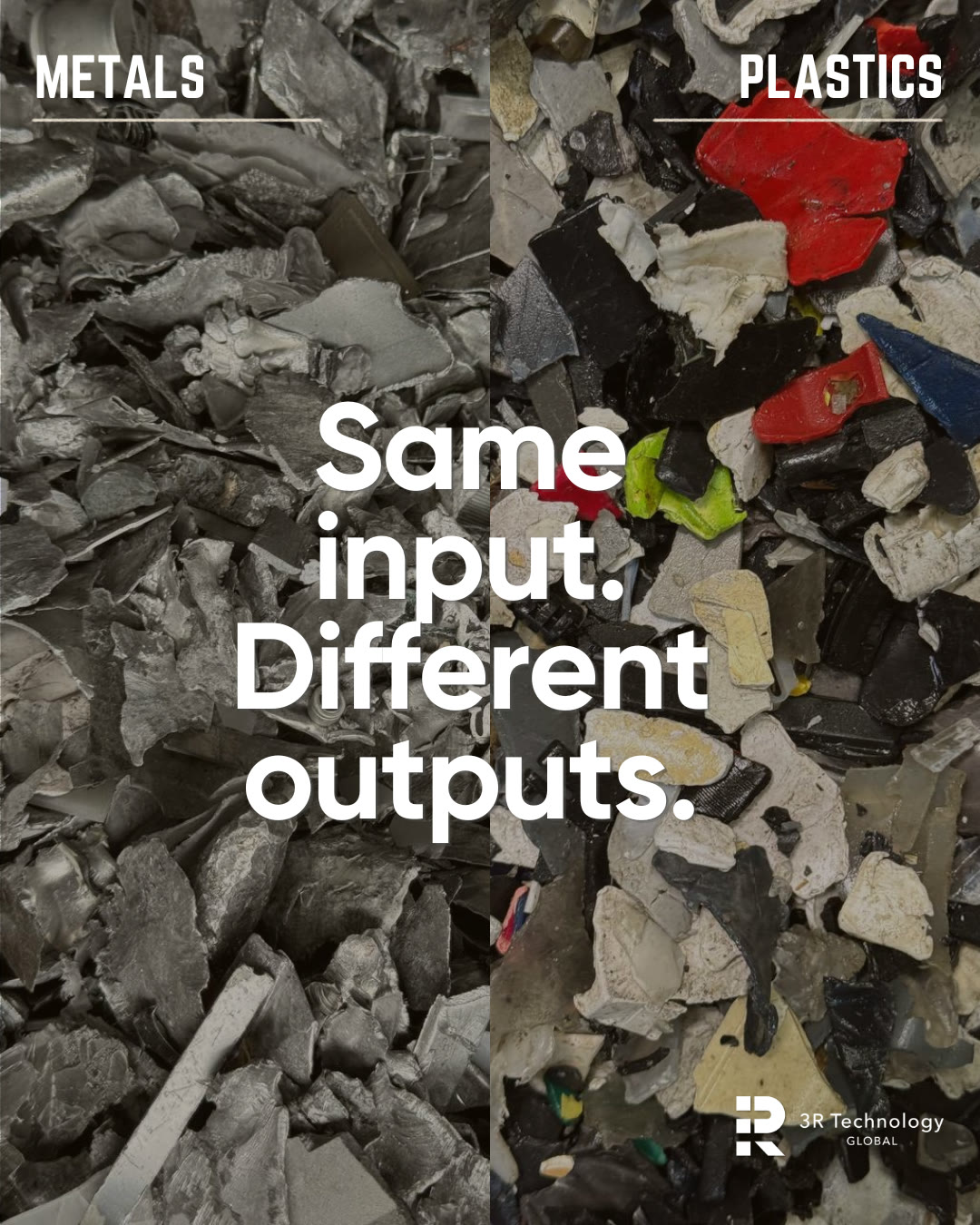
Traditional e-waste recycling focuses narrowly on metals. That made commercial sense for decades — the value was concentrated in a small fraction of the stream.
Printed circuit boards make up around 8% of e-waste by mass, but they carry most of the financial value. Gold, palladium, copper, silver — all densely packed onto PCBs and easy to monetise through established refining routes.
So the industry built itself around metal recovery. Plastics? An afterthought. Often shredded, exported, or landfilled.
The Blind Spot
Around 20% of e-waste is plastic. And here is the catch: roughly 30% of that plastic contains brominated flame retardants (BFRs), which complicate standard recycling and rule out a lot of downstream re-entry pathways.
For most operators, the maths is simple — sort the high-value metals, ship the plastic problem somewhere else.
The result: a stream that could re-enter manufacturing instead becomes landfill.
Same Input, Different Outputs
At 3R Technology Global, we operate metal and plastic recovery lines simultaneously — the same shredded stream feeds both. Our AI-driven Hermion sorting platform separates BFR-containing plastics from clean polymer streams, while the metal fractions head into precious metal recovery.
The result is recovery rates well above the industry baseline on both streams:
- Up to 99% precious metal recovery vs. an 85–90% industry baseline
- 75%+ plastic recovery efficiency vs. 40–60% with traditional recyclers
Across our Preston and Swindon facilities in the UK and our Riverbank, California plant — with a combined annual capacity of around 20,000 metric tonnes — both recovery streams run in parallel, not sequentially.
Why It Matters
When 20% of e-waste is plastic and most of it never gets recovered, the circular economy story has a quiet problem. Calling something "recycling" when you only chase 8% of the value isn't recycling — it's salvage.
Designing both recovery streams into the same line is what closes that loop.
The honest question for the industry: if PCBs carry most of the value, why has e-waste plastic recovery been an afterthought for so long? If you have a view, get in touch — we'd like to hear it.
More News
International E-Waste Day 2026: The Small Stuff Adds Up
Headlamps. Bluetooth keyboards. TV remotes. A toy laptop. One box. Small enough to forget about. That's the problem.
Meet Us at E-Scrap 2026 in New Orleans — Booth #320
3R Technology Global is at E-Scrap 2026, October 26-28 at the Hyatt Regency New Orleans — Booth #320. Got e-waste with nowhere to go? Let's talk.
Meet Us at E-Waste World Expo North America — Stand 325
3R Technology Global is exhibiting at E-Waste World Expo North America, October 28-29 at the Cobb Convention Center, Atlanta — Stand 325. Stop by, say hello and meet the team in person.